Academic project · Design business · 6 min read
Read: Risky Assumption Report
Validating demand, habit formation, and willingness to pay for Read, before writing a line of production code.
Role
Lean validation
Timeline
2.5 weeks testing
Course
INDD-701 Design Business
Tools
Lovable · Supabase · Sheets
Product recap
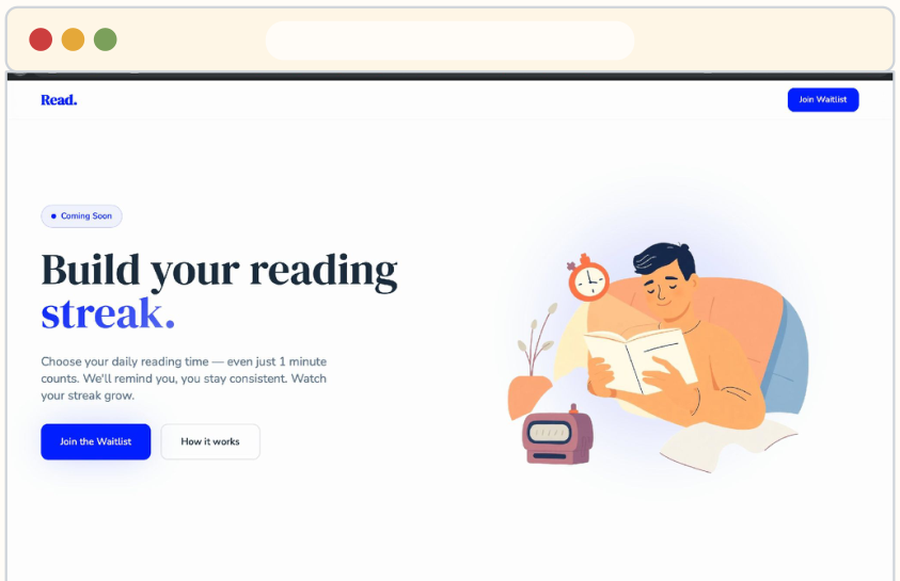
Read: a reading habit tracker.
Read helps casual readers build and keep a daily reading habit by turning short sessions into visible progress. Using the Hook Model (trigger → action → variable reward → investment), the app nudges users back each day through streaks, gentle reminders, and a clean, low-pressure reading experience.
Revenue
Freemium ($2–5/mo) + publisher partnerships
Channels
App stores, university partnerships, book communities
Key costs
Development, hosting, marketing
Partners
Publishers, universities, book influencers
What could kill this idea
Three risky assumptions.
01
Users will actually use the app: if prospective readers are exposed to Read’s value prop, they’ll sign up.
02
Users will form a daily reading habit: new users will log reading sessions for 7 consecutive days within their first 30.
03
Users will commit to pay or pre-reserve: beyond a waitlist, a meaningful share will pledge or reserve a paid tier before the product exists.
All three landed in the same quadrant of the impact × uncertainty matrix (high impact, high uncertainty), meaning all three needed testing before any product got built, not just the riskiest one.
From assumption to test
Three pretotypes, three signals.
Each assumption got its own pretotyping experiment, a classic Savoia-style approach: real signal, no product built.
Pretotyping strategy
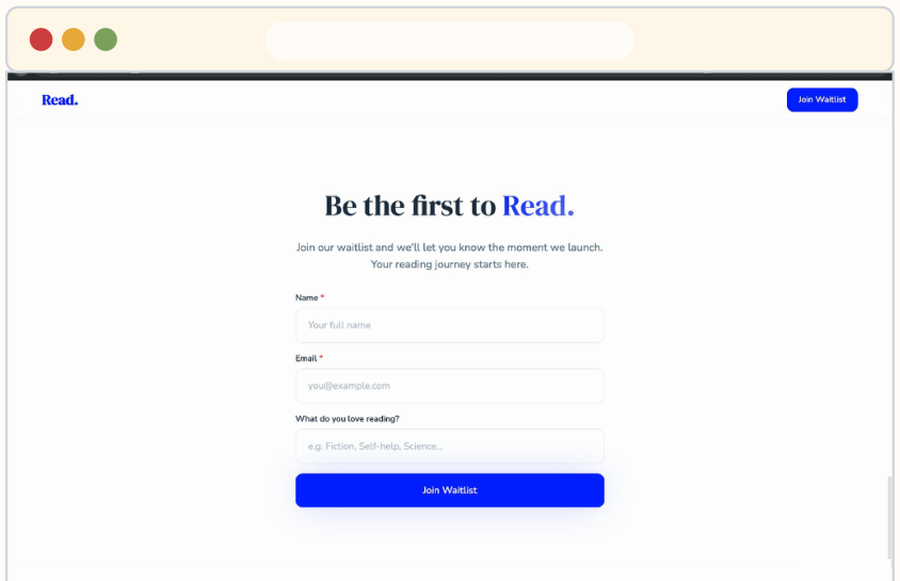
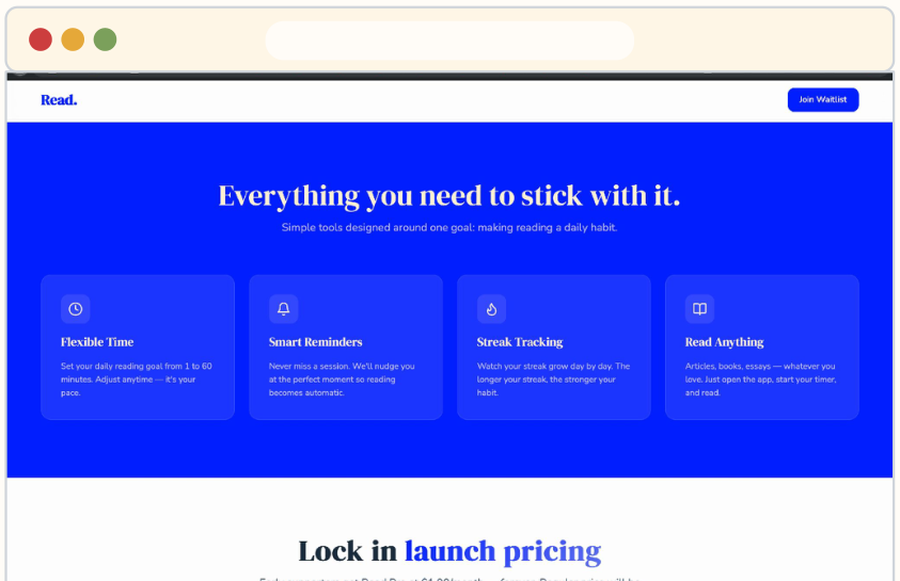
A Coming Soon landing page pitching Read, funneling visitors into a single low-friction waitlist signup capturing name, email, and reading interest. Shared organically for 2.5 weeks to measure raw demand: does anyone outside my immediate circle even want this?
Hypothesis (XYZ)
If prospective customers are exposed to the product and the value it provides, they will sign up for the waitlist, a baseline demand signal.
Artifact
2.5 wks
Timeframe
10
Waitlist signups
Fiction leads early demand (50% of signups).
5 of 10 signups chose Fiction as their primary interest; Self Help was second. Next: lead v1 onboarding with fiction-first framing.
Two acquisition spikes point to one real channel.
Signups clustered around network sharing and a fresh interactive prototype demo. Next: treat the prototype demo as a primary acquisition channel, not just a research tool.
Pretotyping strategy
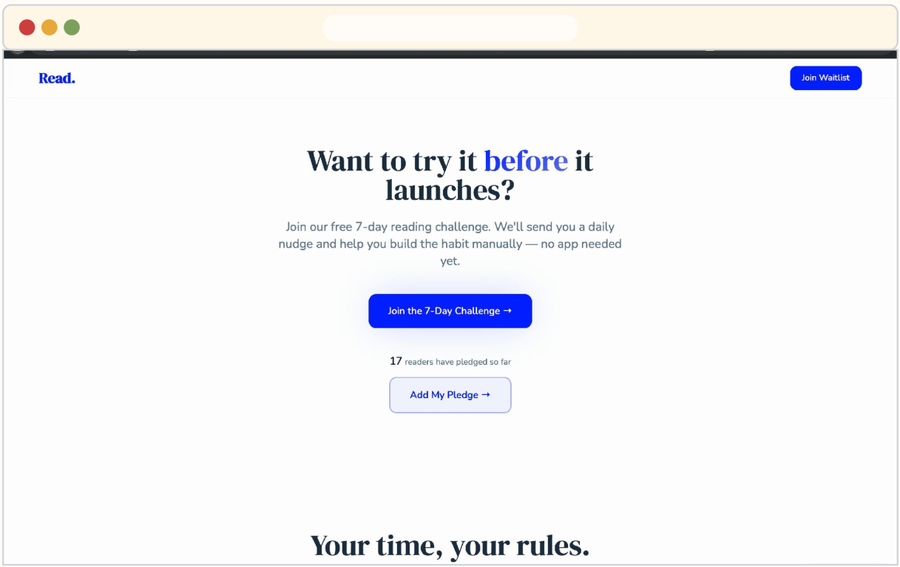
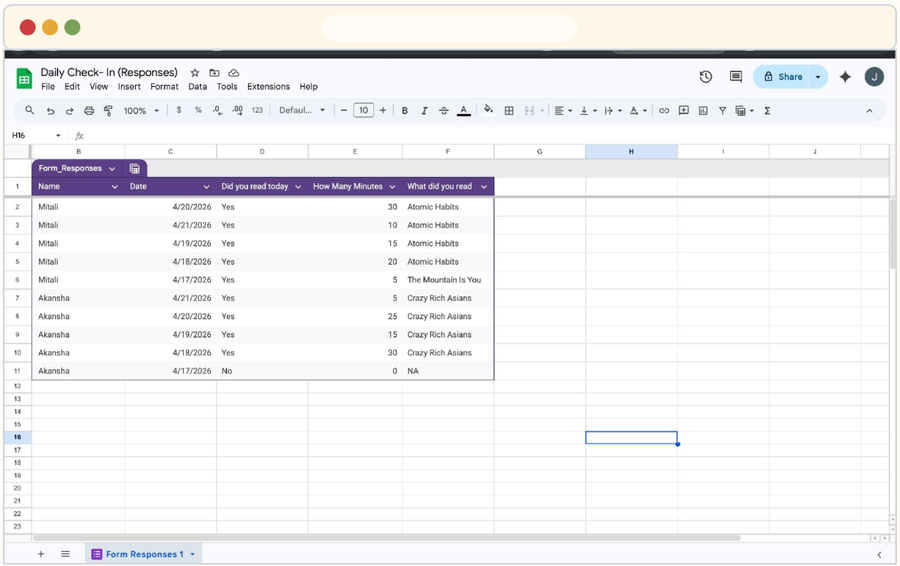
A 7-Day Reading Challenge via a Google Form embedded on the landing page. Participants logged a daily check-in; I manually ran the loop (nudging, reviewing, encouraging), so the 'app' was me behind the scenes.
Hypothesis (XYZ)
At least 40% of new users will log a reading session for 7 consecutive days within their first 30 days.
Artifact
2
Participants
50%
Hit a perfect streak
The habit loop works with only human support.
9 of 10 sessions logged, 17-minute average. 50% hit a perfect consecutive streak, clearing the 40% threshold with nothing but a Google Form and daily nudges.
Book attachment is a leading indicator.
Both participants stuck with one book the entire challenge, no switching. The habit forms around a specific book commitment, not the app itself. Next: make 'what are you reading right now' a first-class onboarding question.
Pretotyping strategy
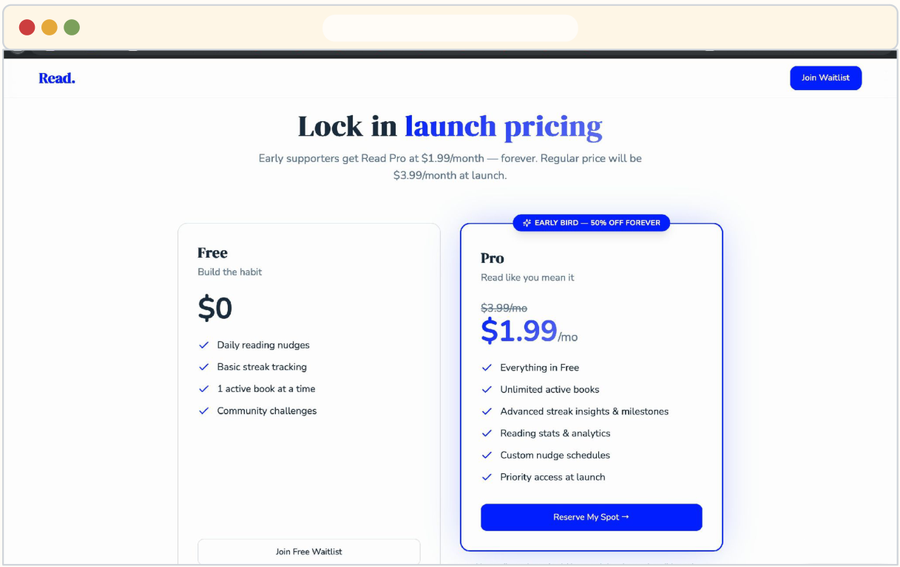
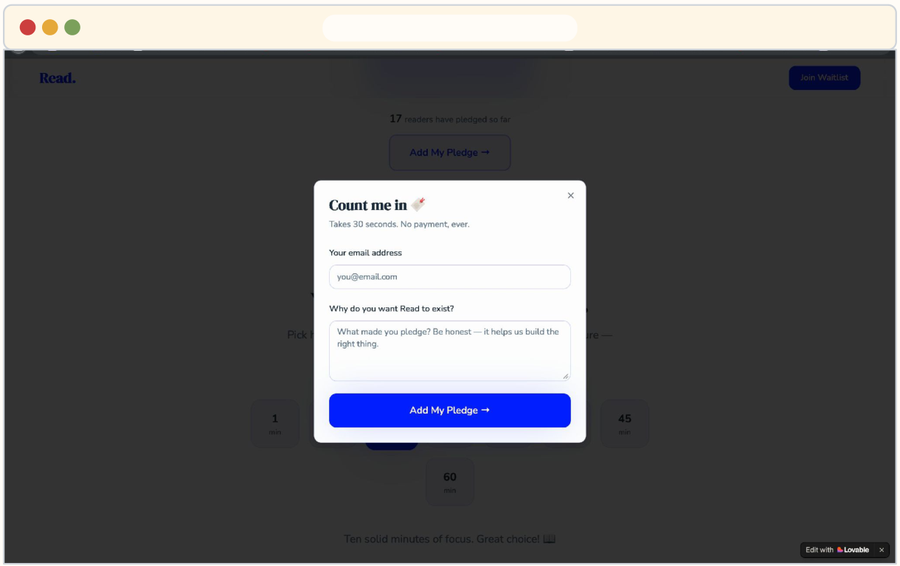
Two pre-sale mechanisms layered onto the landing page: a voluntary pledge with an open-text reason, and a two-tier pricing reservation ($1.99 early-bird / $3.99 regular), no card, no charge, just intent.
Hypothesis (XYZ)
At least 30% of waitlist signups will take a pre-sale action (pledging or reserving a paid tier), a meaningfully stronger commitment than joining a waitlist.
Artifact
10
Waitlist pool
40%
Committed beyond waitlist
Two signals, one clear story.
3 waitlisters wrote a pledge (30%), 4 reserved a paid tier (40%), 3 did both. 40% of the waitlist took at least one pre-sale action, a real willingness-to-pay signal.
A 50/50 price split validates the tier boundary.
2 users chose $1–2/mo and 2 chose $3–5/mo. No one priced out, no one undervaluing it. Next: launch v1 at $1.99 with a clear premium tier at $3.99.
What the tests taught us
Three green lights.
Test 1
Fake Front Door
10 waitlist signups in 2.5 weeks on organic sharing alone.
Test 2
Mechanical Turk
50% hit a perfect consecutive streak with only human support, no app needed.
Test 3
Smoke Test
40% of waitlisters took a real pre-sale action, split evenly across two price tiers.
Back to the reader
Demand is real. The habit works. People will pay.
Test 1 validated raw demand. Test 2 validated the habit loop itself, with book attachment as the leading indicator. Test 3 validated willingness to pay, with a clean 50/50 split between the $1.99 and $3.99 tiers. The idea has demand, commitment, and a working habit loop; time to build v1: fiction-first onboarding, book-level tracking, and a $1.99 launch tier with a clear premium at $3.99.